

This article highlights Asociación Nós Mesmas’ project from Spain, funded by the second cycle of EL*C’s grantmaking programme: Lesbians Against Violence (Combating Gender-Based Violence against Lesbians).
What happens when you experience violence in a relationship, but struggle to recognise it as abuse? For many lesbians, violence within intimate relationships remains difficult to name, discuss and seek support for. When services are designed around assumptions about heterosexual relationships, their experiences can remain invisible even when the harm is very real.
 In Galicia, northwestern Spain, Asociación Nós Mesmas is working to change that. Through its project +Visibles, – Violence: Visibility and Collective Transformation, the organisation combines specialised psychological and legal support with research and community-led cultural activities. Its goal is to make violence against lesbians more visible, improve access to appropriate support, and challenge the social conditions that allow this violence to go unrecognised.
Founded in 2008, Nós Mesmas has long combined community-building with education, advocacy and practical support. Its work responds to a gap in services that are free, safe and equipped to understand the specific experiences of lesbians, including those facing intersecting forms of discrimination.
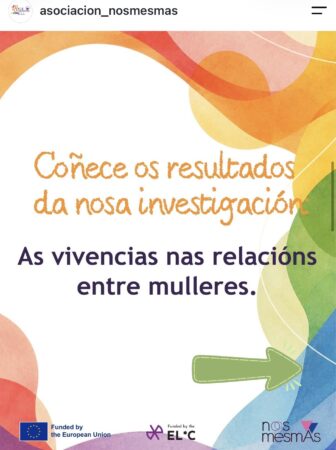 A central part of the project was research into how lesbians perceive and identify violence within relationships between lesbians. The findings were striking: 42% of participants reported having experienced violence within same-sex relationships, while one in four did not know exactly where to seek help.
The research also revealed an important distinction. Participants generally demonstrated considerable knowledge of abusive behaviours, but that knowledge did not necessarily translate into recognising themselves as victims. Understanding what violence looks like in theory does not always make it easy to identify in one’s own relationship.
This matters for prevention and support. If people cannot name what is happening to them, they may struggle to seek help or find services that understand their experiences. The study also identified a need to explain more clearly certain forms of abuse specific to relationships between sexually diverse people.
Nós Mesmas presented the findings publicly and prepared accessible summaries and social media materials to share the results beyond the research itself. The study is not representative of all lesbians in Galicia, but it offers valuable evidence about an often-overlooked reality and points to where awareness and support need to improve.
The project also brought these conversations into a community setting through the second edition of the cultural festival Bolleras, Viciosas, Travelas e Marimachas. The event brought together an audience for a day of art, music, poetry, performance and community connection. Created as a space for expression and resistance, the festival also introduced the project’s support services and encouraged people to participate in the research.
More than an event, it offered an opportunity to bring conversations about violence into a community space shaped by lesbians and other sexually diverse people themselves. The festival helped attract new volunteers and activists and strengthen connections with people beyond the association’s usual circle.
Throughout the project, the association also provided ongoing individual psychological support and specialised legal advice. The legal service addressed a wide range of issues, from discrimination in employment and housing to barriers in accessing healthcare, difficulties with identity documentation, and the challenges faced by migrants and people seeking international protection.
With support from EL*C through its EU-funded grant-making programme against gender-based violence, Nós Mesmas has connected individual care with research and collective action. Its findings underline a difficult reality: even when people know what abusive behaviour looks like, recognising it in their own lives and finding appropriate help can remain challenging.
For Nós Mesmas, making violence visible is not an end in itself. It is a step towards ensuring that lesbians are believed, that their experiences are understood, and that support systems are better equipped to respond when they ask for help.
NOTE: You can learn more about the results of the first cycle of the EL*C’s Grant-Making Programme by reading this article.